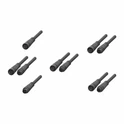
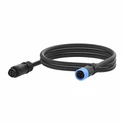
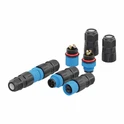
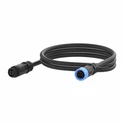
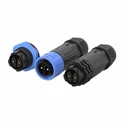
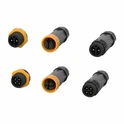
Waterproof connectors are crucial components in modern electrical equipment, and their structural design directly impacts their reliability and safety.In harsh environments such as humidity, dust, and even underwater, waterproof connectors achieve stable electrical connections and reliable environmental protection through sophisticated structural layout and material selection. This article will delve into the structural characteristics and functional implementation mechanisms of waterproof connectors, focusing on their core structural components, key sealing technologies, and the application of materials science.
Core Structural Components
The basic structure of a waterproof connector typically consists of five core components: a plug (male end), a receptacle (female end), a housing, seals, and a contact system. The plug and receptacle, as the main body of the connector, integrate a sophisticated contact system responsible for transmitting current or signals. These contacts are often made of highly conductive materials such as copper alloy and undergo surface treatments such as gold and silver plating to reduce contact resistance and improve corrosion resistance.
The housing structure is the first line of defense for waterproof connectors and is typically made of high-strength engineering plastics or aluminum alloys. The housing not only provides mechanical protection but also serves as a mounting and positioning mechanism. In high-end waterproof connector designs, the housing often utilizes threaded connections, snap-on locking, or push-pull coupling mechanisms to ensure a tight fit during connection. Notably, the housing surface is often designed with waterproof grooves or anti-slip patterns, enhancing both sealing effectiveness and ease of operation.
The sealing system is the core of a waterproof connector's environmental protection. Typical sealing structures include O-rings, gaskets, and potting seals. O-rings are typically made of elastic materials such as silicone rubber and fluororubber. They are installed in the sealing groove of the connector housing and compress during connection to form a radial seal. For higher levels of protection, multiple sealing designs may be employed within the connector, such as independent sealing structures around the contacts or compression-type sealing sleeves at the cable entry point.
Key Sealing Technologies
The sealing performance of waterproof connectors is primarily achieved through two technical approaches: contact sealing and non-contact sealing. Contact sealing is the most common sealing method, relying on the elastic deformation of the sealing element under pressure to fill the interfacial gap. O-rings are widely used due to their simple structure and reliable sealing performance. A well-designed O-ring sealing system must consider multiple factors, including compression rate, elongation, and sealing surface finish, to ensure stable sealing performance despite temperature fluctuations and mechanical stress.
Non-contact sealing technologies include gap seals and labyrinth seals. These seals do not rely on elastic deformation of the material, but instead utilize precisely designed geometry to prevent liquids from passing through tortuous channels. In waterproof connectors, labyrinth seals are often used at cable entry points. Their multi-layered, stepped structure extends the liquid penetration path, and combined with a hydrophobic coating, they significantly enhance protection. For extreme environment applications, some high-end connectors utilize dry gas filling or vacuum sealing to completely isolate the internal space from the external environment.
Cable sealing presents a particular challenge in waterproof connector design. Due to the diverse materials and diameters of cable jackets, connectors often feature removable cable sealing components, such as compression nuts, compression sleeves, or heat shrink tubing. Advanced cable sealing solutions utilize a molding process to completely encapsulate the cable and connector interface, creating a seamless protective layer. This structure not only effectively provides water resistance but also resists mechanical strain and chemical corrosion, making it particularly suitable for reliable connections in high-vibration environments.
Material Science and Surface Treatment
The material selection for waterproof connectors directly impacts their durability and environmental adaptability. The housing material must meet requirements for mechanical strength, processability, and environmental protection. Commonly used engineering plastics such as PA66 and PBT offer excellent chemical resistance and dimensional stability, while high-end applications utilize UL94 V-0 flame-retardant materials or glass fiber-reinforced composites. For applications requiring higher mechanical strength, aluminum alloy or stainless steel housings treated with anodizing or electroplating achieve lightweight advantages while achieving excellent corrosion resistance.
The selection of contact material is guided by the principle of balancing high conductivity and wear resistance. Copper alloys such as phosphor bronze and beryllium copper are the mainstream choice due to their excellent conductivity and mechanical properties. Surface treatment is crucial to contact reliability. Gold plating offers the lowest contact resistance and best oxidation resistance, but is costly. Tin plating offers good solderability but is susceptible to oxidation. A nickel underlayer is often used as an intermediate layer to improve the plating's adhesion and wear resistance. In modern connector design, selective plating technology is often used, applying precious metal coatings to contact areas and using less expensive materials in non-contact areas to optimize performance and cost.
Advances in sealing materials have significantly expanded the environmental adaptability of waterproof connectors. Fluororubber (FKM) offers excellent high-temperature and chemical resistance, making it suitable for automotive and industrial applications. Silicone rubber (VMQ) maintains elasticity at low temperatures, making it suitable for outdoor and polar applications. Hydrogenated nitrile rubber (HNBR) is renowned for its excellent oil and wear resistance. New nanocomposite sealing materials are under development. By adding nanofillers, they improve the mechanical properties and aging characteristics of traditional rubber materials, providing a material foundation for the development of future high-performance waterproof connectors.
Structural Innovation and Future Trends
The structural design of modern waterproof connectors is evolving towards modularity, miniaturization, and intelligence. Modular design allows users to combine different functional connection units according to their needs, simplifying the maintenance and upgrade of complex systems. The trend towards miniaturization is driving connector size reductions while maintaining protection levels. For example, the M8/M12 series circular connectors are widely used in industrial automation. Smart connectors integrate sensors and monitoring circuits to detect connection status, temperature changes, and seal integrity in real time, providing data support for predictive maintenance.
In terms of structural optimization, the application of computer-aided design (CAD) and finite element analysis (FEA) technologies enables precise assessment of stress distribution and fluid dynamics in waterproof connectors. 3D printing technology provides flexible solutions for prototyping and small-batch production, particularly facilitating the implementation of complex internal flow channel structures. Environmental protection requirements are driving the use of halogen-free materials and recyclable design concepts, and environmentally friendly waterproof connectors compliant with international standards such as RoHS and REACH are becoming mainstream in the market.
Future structural innovations in waterproof connectors will place greater emphasis on multi-physics collaborative design and full-lifecycle reliability. Through interdisciplinary integration, connectors will maintain excellent waterproof performance while further enhancing electromagnetic compatibility (EMC), mechanical durability, and environmental adaptability. With the development of the Internet of Things and new energy technologies, specialized waterproof connectors suitable for extreme environments (such as deep sea, space, and high-radiation areas) will become a research and development hotspot. Their structural design will break through conventional thinking and usher in a new chapter in electrical connection technology.