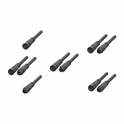
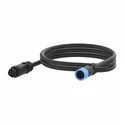
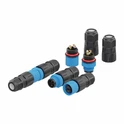
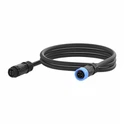
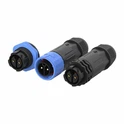
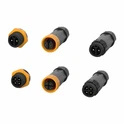
In fields such as industrial automation, outdoor communications, and marine engineering, the reliable operation of equipment places higher demands on connector protection. As a key foundational component, the technological evolution of waterproof connectors directly impacts the stability and safety of system integration.
The core function of waterproof connectors is to provide electrical connections while blocking liquid penetration. Traditional products achieve basic protection through rubber seals and threaded locking mechanisms, typically reaching IP67 standards and maintaining a seal even after immersion in water at a depth of 1 meter for 30 minutes. As application scenarios become more complex, newer generation products utilize multi-layer composite sealing technology, combining the synergistic effects of fluororubber and silicone materials. This allows for continuous underwater operation at an IP68 protection level, and some specialized models can even withstand high-pressure water jets and chemical corrosion.
Advances in materials science have significantly improved connector performance. The combination of gold-plated contacts and an oxidation-resistant alloy housing ensures stable contact resistance and enhanced resistance to salt spray corrosion. In terms of structural design, modular snap-on connections replace traditional threaded fastenings, increasing installation efficiency by 40% while ensuring a secure seal. To meet the needs of high-frequency signal transmission, some products integrate electromagnetic shielding layers, enabling data transmission rates exceeding 10Gbps while maintaining full waterproof performance.
Market applications are showing a trend of diversification. In the new energy vehicle sector, the demand for waterproof connections between battery packs and control systems is driving product miniaturization and high current. 5G base station construction requires connectors to maintain stable performance across a wide temperature range. Marine observation equipment and underwater robots are placing higher standards on the compressive strength of connectors, and related products have achieved breakthrough applications with an operating depth of 600 meters.
Future technological development will focus on the integration of intelligent monitoring functions. With built-in pressure sensors and humidity detection chips, new connectors provide real-time feedback on sealing status, enabling early warning systems to proactively identify potential risks. The use of environmentally friendly materials will also become a key focus. The development of bio-based polymers and recyclable metal materials will drive the industry's transition towards sustainable development.