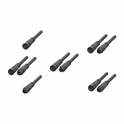
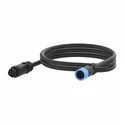
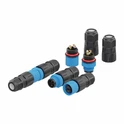
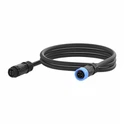
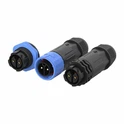
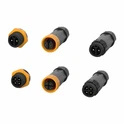
Waterproof connectors, as key sealing components in electronic devices, are widely used in industrial automation, automotive electronics, outdoor communications, and medical equipment.Their core function is to ensure stable and reliable electrical connections while effectively blocking the intrusion of external environmental factors such as moisture and dust. This article will systematically explain the implementation of waterproof connectors from four perspectives: material selection, structural design, sealing processes, and testing and verification.
I. Material Selection: Balancing Weather Resistance and Conductivity
The performance of waterproof connectors depends primarily on the properties of the base material. The housing material must possess high strength, corrosion resistance, and excellent weather resistance. Commonly used materials include engineering plastics such as PA66 (nylon 66) and PBT (polybutylene terephthalate) or metals such as stainless steel and aluminum alloy. PA66 is the preferred choice for most mid-range waterproof connectors due to its excellent insulation, impact resistance, and high-temperature resistance (long-term operating temperature up to 120°C). Metal housings are more suitable for applications requiring high mechanical strength, such as construction machinery, but they are more expensive and require additional insulation treatment. Conductive components (such as pins and sockets) are typically made of copper alloys (such as phosphor bronze and beryllium copper). Gold, nickel, or tin plating is used to enhance oxidation resistance and contact reliability. While gold plating is more expensive, it effectively reduces contact resistance and enhances corrosion resistance, making it suitable for high-precision medical or aerospace equipment. Nickel plating offers a balance of wear resistance and cost-effectiveness, making it a common choice for mid- to high-end products.
II. Structural Design: Multi-Level Sealing Mechanism
The sealing effectiveness of waterproof connectors relies on scientific structural design, the core of which is to block liquid penetration paths through physical barriers. Common sealing solutions include:
1.Double O-ring Compression Seal: Two rubber O-rings (usually silicone rubber or fluororubber) are placed at the mating interface of the plug and receptacle. A radial seal is formed through axial compression (compression controlled at 20%-30%). Fluororubber (FKM) is more suitable for harsh environments due to its oil resistance and high-temperature resistance (-20°C to 200°C). Silicone rubber (VMQ) is suitable for low-temperature applications (above -50°C) due to its flexibility.
2.Secondary Locking Structure: To prevent the O-ring from loosening due to vibration, connectors are often designed with a secondary locking mechanism (such as a snap or thread) to ensure a tight fit after mating. For example, M12 series waterproof connectors often use a threaded + O-ring combination. The thread tightening torque must be strictly controlled within the manufacturer's recommended value (e.g., 2-3 N·m) to prevent overpressure and rubber deformation and failure.
3.Cable Entry Seal: The connection between the cable and the connector is a common weak point for water seepage. Solutions include:
•Heat Shrink Tubing + Glue Filling: After inserting the cable into the connector, secure it with heat shrink tubing and heat-shrink it, then inject epoxy resin or silicone to fill the gap.
•Compression Nut + Sealing O-Ring: The nut compresses an internal rubber ring (such as nitrile rubber), utilizing the rubber's elastic deformation to achieve a dynamic seal. This is suitable for frequent plugging and unplugging.
III. Sealing Process: The Key to Precision Manufacturing
During the production process of waterproof connectors, the precision of the sealing process directly affects the final performance. Key steps include:
•Rubber component pre-molding: O-rings must be injection molded to ensure dimensional tolerances within ±0.05mm to prevent leakage due to excessive looseness or increased insertion and removal resistance due to excessive tightness.
•Surface treatment: The housing must be deburred, cleaned (e.g., ultrasonic cleaning to remove oil stains), and dried to prevent impurities from affecting the seal contact surface.
•Assembly sequence: First, install and secure the conductive components, then insert the O-rings, and finally assemble the housing to prevent displacement or damage to the rubber components during assembly.
IV. Testing and Verification: A Necessary Step to Ensure Reliability
To verify the actual performance of waterproof connectors, their sealing level must be assessed through standardized testing. Internationally recognized testing standards include IEC 60529 (IP ratings) and UL 50E (Enclosure Protection), with IP67 and IP68 being the most common waterproofing requirements:
•IP67 test: The connector is fully immersed in water at a depth of 1 meter for 30 minutes. The test requires no internal signs of water intrusion and an insulation resistance of 100 MΩ or higher.
•IP68 test: Based on a user-defined depth and duration (e.g., 2 meters for 24 hours), the connector must undergo high-pressure water jets (80-100 bar) and long-term immersion.
•Additional testing includes salt spray testing (96 hours to verify corrosion resistance), vibration testing (10-2000 Hz to simulate mechanical shock), and high-temperature cycling (-40°C to 85°C to verify material stability).
Conclusion
The design and implementation of waterproof connectors is an intersection of materials science, mechanical engineering, and precision manufacturing. Through appropriate material selection, optimized structure, refined processes, and rigorous testing, long-term stable operation in complex environments can be ensured. In the future, with the rapid development of 5G communications, new energy vehicles and other fields, the demand for waterproof connectors with high temperature resistance, high frequency transmission and miniaturization will further promote technological innovation and bring more efficient solutions to the industry.