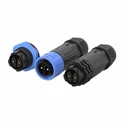
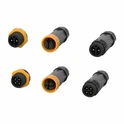
As a critical sealing component in electronic devices, waterproof connectors' molding process directly impacts their waterproof performance, mechanical strength, and service life. The manufacturing process requires a combination of materials science, mold design, and precision machining to ensure stable performance even in harsh environments.
Material Selection and Pretreatment
Waterproof connectors typically utilize high-performance engineering plastics (such as PA66 and PBT) or thermoplastic elastomers (TPEs), which offer excellent weather resistance, impact resistance, and insulation properties. Some high-end products utilize composite materials with added glass fiber for enhanced structural strength. Before molding, the raw materials must be dried to prevent moisture buildup that could cause bubbles or sink marks, compromising sealing.
Injection Molding Process
Injection molding is the core molding method for waterproof connectors. Plastic material is melted at high temperature and injected under high pressure into a precisely designed mold cavity. After cooling and solidification, complex internal structures (such as terminal holes and sealing grooves) are formed. The molds require high-precision CNC machining to ensure tolerances within ±0.01mm, and a multi-stage demolding mechanism is designed to prevent product deformation. In addition, injection molding parameters (such as temperature, pressure, and cooling time) must be optimized based on material properties to prevent defects such as short-cuts and flash.
Secondary Processing and Sealing Enhancement
Molded connectors often require secondary processes to enhance their waterproofness. For example, ultrasonic or laser welding can be used to seal housing seams; pin holes can be filled with adhesive (such as epoxy) to fill small gaps; or rubber rings can be used to enhance the dynamic waterproofness of the interface. Some products also undergo airtightness testing (such as helium mass spectrometry) to ensure they meet IP67/IP68 protection standards.
Quality Control and Innovation Trends
Modern waterproof connector production emphasizes full-process monitoring, including material composition analysis, injection molding process parameter recording, and finished product non-destructive testing. With the development of 5G and new energy vehicles, lightweighting, miniaturization, and molding processes with higher temperature resistance (such as micro-foam injection molding and two-color injection molding) will become research and development priorities, driving waterproof connectors towards higher reliability.