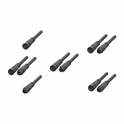
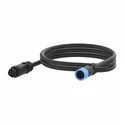
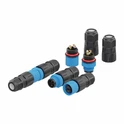
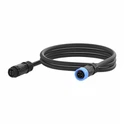
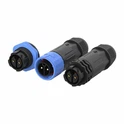
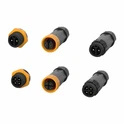
Waterproof connectors, as key sealing components in electrical equipment, are widely used in industrial, outdoor, automotive, and medical applications. Their core function is to ensure stable transmission of current and signals in humid, submerged, or highly corrosive environments. However, the performance requirements for waterproof connectors vary significantly across different applications, leading to diverse characteristics in terms of structural design, material selection, protection level, and applicable environments. This article will systematically explain the key differences between waterproof connectors from four perspectives: protection level, structural type, material processing, and application scenario.
I. Differences in Protection Rating (IP Standard)
One of the core performance indicators of waterproof connectors is the internationally recognized IP rating (Ingress Protection). This standard consists of two digits: the first digit indicates dustproofness (levels 0-6), and the second digit indicates waterproofness (levels 0-9). Common waterproof connectors typically meet IP67 or IP68 ratings. IP67 indicates resistance to immersion in water up to 1 meter for 30 minutes, while IP68 supports deeper water depths (e.g., over 1.5 meters) or longer durations (e.g., continuous immersion for several hours). For extreme environments (such as underwater equipment or marine engineering), some high-end connectors must meet IP69K ratings, meaning they can withstand the impact of high-pressure, high-temperature water jets (e.g., 80°C water jets at 80-100 bar). These products are often used in the hydraulic systems of food processing machinery or heavy construction equipment.
It's important to note that a higher level of protection isn't necessarily better; cost and performance must be balanced based on the specific use case. For example, household outdoor lighting only requires IP65 (sprayproof); opting for IP68 connectors would increase unnecessary expenses. Meanwhile, connectors for submersible cameras that only meet IP67 ratings could short-circuit due to water pressure penetration during deep dives.
II. Classification and Differences in Structural Types
The structural design of waterproof connectors directly affects their sealing effectiveness and ease of installation. Common types can be categorized as thread-locking, snap-on, push-pull, and flange-mounted.
Thread-locking is the most traditional structure, achieving a seal by rotating internal and external threads and applying pressure. Typical examples include industrial connectors such as M12 and M23. This type of connector offers strong sealing (often using O-rings and rubber gaskets) and is suitable for applications subject to frequent vibration, such as motor junction boxes. However, installation is time-consuming and requires specialized tools.
Snap-on connectors (such as common waterproof USB connectors) rely on a spring-loaded latch for quick locking. Their advantage is plug-and-play functionality, making them suitable for devices subject to frequent plugging and unplugging, such as outdoor lighting control modules. However, their sealing relies on the compression of the silicone seal, which can degrade over time and typically limits their protection rating to IP65-IP67.
Push-pull connectors utilize an internal spring-loaded latch for one-handed operation, eliminating the need for twisting or pressing. They are typically used in medical devices (such as portable monitors) or for wiring harness connections in confined spaces. This design offers both quick connection and reliable sealing, but requires extremely high manufacturing precision and is relatively expensive.
Flange-mounted connectors use bolts to secure the connector directly to the equipment panel. They are commonly used in large electromechanical systems, such as wind turbine converter cabinets. Their sealing relies on the tight fit between the metal flange and the sealing gasket, and they can withstand high-pressure airflow or chemically corrosive media.
III. Key Differences in Materials and Processes
The durability of waterproof connectors is closely related to their housing materials, sealing materials, and surface treatment.
Housing materials typically include aluminum alloy (lightweight and resistant to electromagnetic interference), stainless steel (highly corrosion-resistant, suitable for chemical environments), or engineering plastics (such as PA66+GF, low cost and excellent insulation). For example, connectors for marine environments often use 316L stainless steel housings for their resistance to salt spray corrosion; whereas waterproof plugs in consumer electronics prefer ABS+PC plastics, balancing weight and cost.
Sealing materials are primarily silicone rubber (high and low temperature resistance, -50°C to 200°C), fluororubber (oil and chemical solvent resistance), and polyurethane (high elasticity and tear resistance). High-end industrial connectors often utilize multi-layer sealing structures-for example, a primary sealing ring around the contacts and a secondary sealing ring at the housing joint to ensure that even if one seal fails, the basic protective function is maintained.
Surface treatment processes include electroplating (such as nickel plating for rust protection), anodizing (to improve the wear resistance of aluminum alloys), and spray coating (such as PTFE coating for enhanced chemical resistance). For connectors exposed to the outdoors for extended periods, surface treatment can significantly extend their service life. For example, for every 5μm increase in nickel plating thickness, the salt spray corrosion resistance can be extended by approximately 200 hours.
IV. Differences in Adaptability by Application Scenarios
Waterproof connectors in different industries require optimized designs for specific environments.
•Industrial sectors (such as automated production lines): Connectors are required to withstand high temperatures (-40°C to 125°C), vibration (accelerations exceeding 5G), and oil and dirt. Heavy-duty threaded connectors are often used, along with shielding to prevent electromagnetic interference.
•Outdoor lighting (such as streetlights and landscape lights): Weather resistance (UV radiation and rain) is a key concern. IP66/IP67-rated plastic housings and silicone rubber seals are often used, with cost control prioritizing extreme protection performance.
•Automotive electronics (such as charging stations and sensors): They must meet automotive-grade standards (such as ISO 20653). In addition to waterproofing, they must also be vibration-resistant (compliant with SAE J2380 vibration testing) and flame-retardant (UL94 V-0 rating). Connectors are clearly trending towards miniaturization.
•Medical devices (such as endoscopes and infusion pumps): Emphasizing biocompatibility (non-toxic materials) and high-frequency signal transmission stability (for example, waterproof plugs for high-frequency surgical instruments must support GHz-level signals), gold-plated contacts are often used to reduce contact resistance.
Conclusion
The differences between waterproof connectors are essentially the precise matching of performance requirements with the operating environment. From the refinement of protection levels to innovations in structural design, from advances in materials science to in-depth process optimization, each difference serves the reliability goals of specific scenarios. When making a selection, users should comprehensively consider cost, installation method, life expectancy, and environmental challenges, rather than blindly pursuing high-end specifications. With the rapid development of the Internet of Things and new energy industries, waterproof connectors will continue to evolve towards miniaturization, intelligence (such as integrated condition monitoring sensors), and environmental friendliness (recyclable materials), and their technological differentiation will also become more refined.