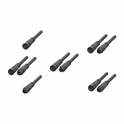
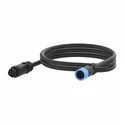
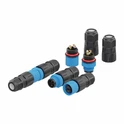
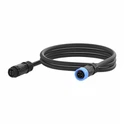
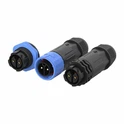
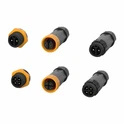
As a critical sealing component in electrical equipment, waterproof connectors must be designed and manufactured in strict accordance with the principles of waterproofing, insulation, and durability.Their assembly involves the precise coordination of multiple core components to ensure stable signal or power transmission in harsh environments, such as humid and underwater environments.
First, the choice of housing material is fundamental to waterproofing. High-strength engineering plastics (such as PA66 and PBT) or metals (such as stainless steel and aluminum alloys) are typically used, molded through injection molding or die casting. The housing must be impact- and corrosion-resistant, and designed with threads, snap-fits, or sealing grooves to ensure a tight seal with the mating connector.
Second, the sealing ring (O-ring) is a key component in achieving waterproofing. It is often made of elastic materials such as silicone rubber and fluororubber, molded into an annular structure and inserted into the housing's sealing groove. When the connectors are mated, the sealing ring deforms under pressure, filling the gap and forming a multi-layered waterproof barrier. Some high-end products also utilize double O-rings or radial seals to further enhance protection levels (such as IP67/IP68).
The assembly of the terminal and insulator is equally critical. Conductive terminals are typically made of a copper alloy with gold or nickel plating. After being stamped or crimped, they are inserted into an insulator made of a high-insulation engineering plastic (such as PTFE or LCP). The insulator not only isolates adjacent terminals but also needs to fit tightly with the housing to prevent moisture from penetrating through gaps.
Finally, the overall assembly process requires reinforcement through methods such as glue injection, ultrasonic welding, or laser welding. For example, epoxy or polyurethane potting compound can be injected into the cable-connector junction to completely isolate it from moisture intrusion.
Through the coordinated design of these components, waterproof connectors achieve a unified combination of structural sealing, electrical reliability, and environmental adaptability, and are widely used in industrial equipment, automotive electronics, and marine engineering.