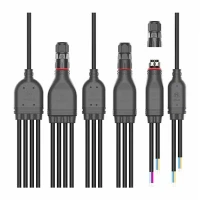
What is the contact force of a Bulk T type connector?
As a supplier of Bulk T type connectors, I often encounter questions from customers about various technical aspects of our products. One of the most frequently asked questions is about the contact force of a Bulk T type connector. In this blog post, I will delve into what contact force is, its significance in Bulk T type connectors, and how it impacts the performance of these connectors.
Understanding Contact Force
Contact force refers to the force exerted between the contact elements of a connector when they are mated. In the context of a Bulk T type connector, this force is crucial for establishing and maintaining a reliable electrical connection. When two contact elements come into contact, the contact force ensures that there is sufficient pressure between them to minimize electrical resistance. A low contact force may result in a poor connection, leading to increased resistance, heat generation, and potential signal loss. On the other hand, an excessive contact force can cause damage to the contact elements, such as deformation or wear, which can also degrade the performance of the connector over time.
The contact force in a Bulk T type connector is typically determined by several factors. The material properties of the contact elements play a significant role. For example, materials with high elasticity can provide better contact force stability. The design of the contact structure also affects the contact force. A well - designed contact structure can distribute the force evenly across the contact area, ensuring a more reliable connection. Additionally, the manufacturing process can impact the contact force. Precise manufacturing techniques can ensure that the contact elements are formed to the correct dimensions, which is essential for achieving the desired contact force.


Significance of Contact Force in Bulk T Type Connectors
In Bulk T type connectors, the contact force is of utmost importance for several reasons. Firstly, it directly affects the electrical performance of the connector. A proper contact force ensures a low - resistance electrical path, which is essential for the efficient transmission of electrical signals. This is particularly important in applications where high - speed data transfer or high - power transmission is required. For example, in industrial automation systems, Bulk T type connectors are often used to connect sensors, actuators, and control devices. A reliable electrical connection with low resistance is necessary to ensure the accurate and timely transmission of data and power, which is crucial for the proper operation of the entire system.
Secondly, the contact force influences the mechanical stability of the connector. A sufficient contact force helps to keep the contact elements firmly in place, preventing them from loosening due to vibrations, shocks, or other mechanical stresses. This is especially important in harsh environments where the connector may be subjected to significant mechanical forces. For instance, in automotive applications, Bulk T type connectors are used in various parts of the vehicle, including the engine compartment and the chassis. These connectors need to withstand the vibrations and shocks generated during vehicle operation, and a proper contact force is essential to ensure their long - term reliability.
Measuring and Controlling Contact Force
Measuring the contact force of a Bulk T type connector is a critical step in the quality control process. There are several methods available for measuring contact force. One common method is to use a force gauge. A force gauge can be used to measure the force required to separate the mated contact elements. This provides a direct measurement of the contact force. Another method is to use strain gauges. Strain gauges can be attached to the contact elements, and they can measure the deformation of the contact elements under load. By analyzing the deformation data, the contact force can be calculated.
Controlling the contact force during the manufacturing process is also essential. This can be achieved through precise control of the material properties, contact structure design, and manufacturing processes. For example, by carefully selecting the materials with the appropriate elasticity and hardness, the contact force can be optimized. The design of the contact structure can be adjusted to ensure that the force is distributed evenly. Additionally, strict quality control measures can be implemented during the manufacturing process to ensure that the contact elements are produced to the correct specifications, which helps to maintain the consistency of the contact force.
Our Bulk T Type Connectors and Contact Force
As a supplier of Bulk T type connectors, we understand the importance of contact force in the performance of our products. We have invested heavily in research and development to optimize the contact force of our Bulk T type connectors. Our engineers use advanced simulation tools to design the contact structure, ensuring that the force is distributed evenly across the contact area. We also carefully select high - quality materials for our contact elements, which have excellent elasticity and electrical conductivity.
In addition to our Bulk T type connectors, we also offer a wide range of other waterproof connectors, such as the M27 Straight Type Waterproof Connector, M20 Straight Type Waterproof Connector, and M18 Straight Type Waterproof Connector. These connectors also feature high - quality contact elements with optimized contact force, ensuring reliable electrical connections in various applications.
Conclusion
In conclusion, the contact force of a Bulk T type connector is a critical parameter that directly affects the electrical and mechanical performance of the connector. A proper contact force ensures a low - resistance electrical connection, mechanical stability, and long - term reliability. As a supplier, we are committed to providing high - quality Bulk T type connectors with optimized contact force. Our products are designed and manufactured to meet the highest standards, ensuring reliable performance in a wide range of applications.
If you are interested in our Bulk T type connectors or other waterproof connectors, we invite you to contact us for more information and to discuss your specific requirements. We look forward to the opportunity to work with you and provide you with the best - in - class connector solutions.
References
- "Connector Handbook" by Jack G. Bannister
- "Electrical Connector Design Handbook" by William A. Kelsey
- Technical papers on connector technology published in industry - leading journals such as IEEE Transactions on Components, Packaging and Manufacturing Technology.